Thursday, January 5, 2017

Piece by Piece

So, after the red vermouth tragedy, I thought I'd deflect my exploratory smoking away from one of the main components, so as not to ruin another batch of anything. Although this doesn't qualify as "molecular" exploration, even in the culinary world, I shifted my focus onto the garnish end of things. Think "component" rather than "molecule", and you'll see where I'm headed.


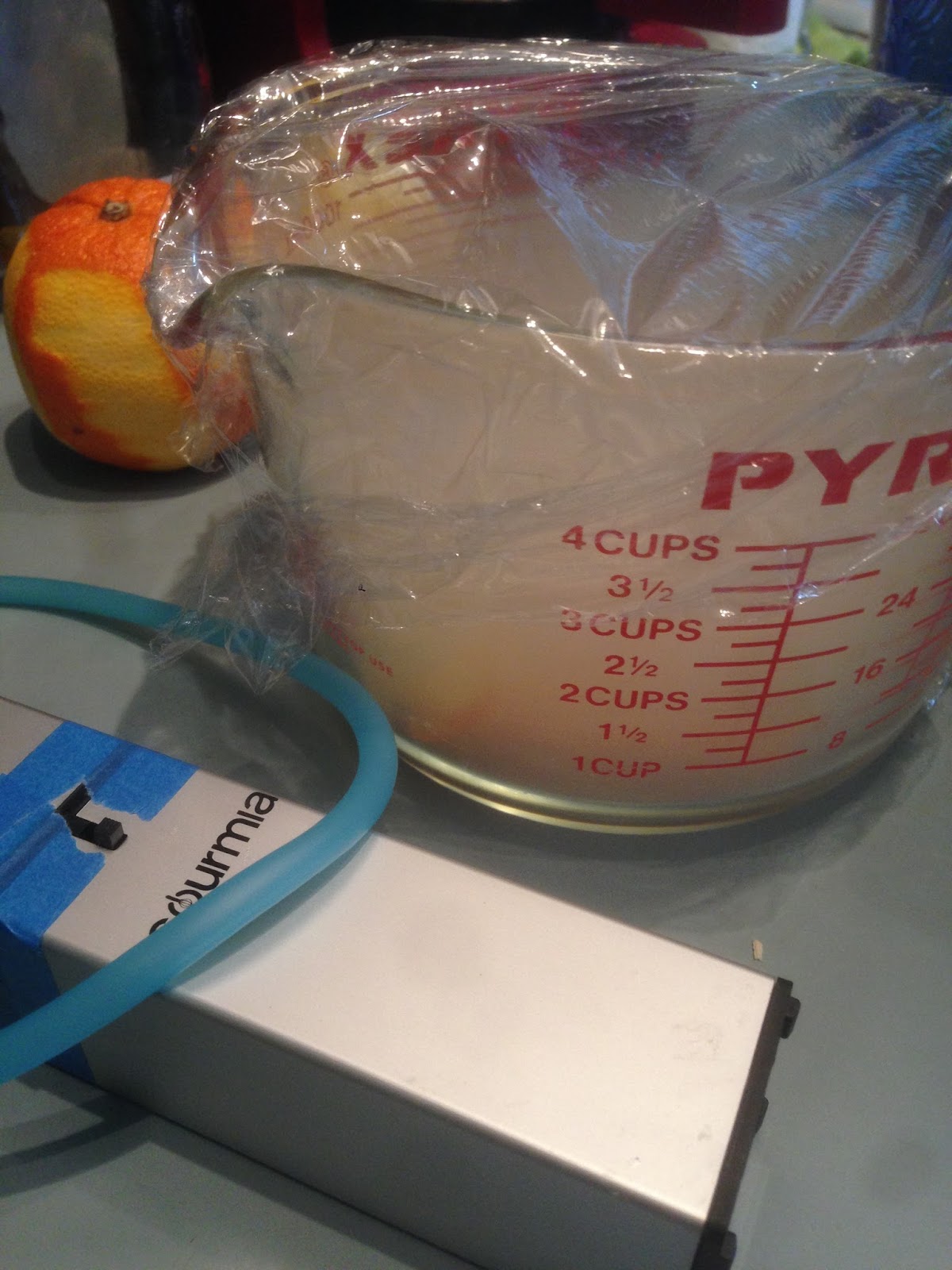
I cherry-wood smoked a small batch of citrus peel. Hoping to avoid the over-smoking of the red vermouth, I just did a single burn, filling the measuring cup, then sealing it with plastic wrap and allowing the smoke to settle/dissipate/whatever naturally over the course of a few hours. By the time 5:00 rolled around, I was ready for the taste test.


Keeping my variables constant, I mixed my two base drinks -- a dry Martini and a Manhattan, ingredients as follows:

Martini:
2 parts Aviation Gin
1 part Martini Extra-Dry Vermouth
Cherry-Smoked lemon peel

Manhattan:
2 parts Dickel Rye
1 part Carpano Vermouth
Cherry-Smoked Blood Orange Peel

The effect of the smoked citrus was subtle and delightful in the drinks. It added a bit of dark-scented heft to the Martini, just a tad more body than an ultra-dry drink. A perfect addition to the winter months. In the Manhattan, it enhanced the spiciness of the orange peel, giving another dimension to my go to drink.

Next: even further off the smoked path.

Wednesday, January 4, 2017

One Step Forward...

After yesterday's success with the bianco vermouth, I assumed red vermouth would be a no-brainer. And yet... it didn't work that way. I put 3 oz. Punt e Mes red vermouth into a quart jar and hickory-smoked it two times, as with the white vermouth.


The result was very fragrant of woodsmoke, so my hopes were high. Tasting the vermouth on its own, it had a raw stale smoke finish to it. Thinking perhaps it would mellow when combined in a drink, I mixed a standard Manhattan.


2 parts Dad's Hat Rye (Vermouth-Barrel Finish)
1 part hickory-smoked vermouth
Dash Number 11 Cherry Bitters

While the smell of hickory was pleasant, the finish on the drink was somewhere between expressed coffee grounds and dirty ashtray. I mean, I finished the drink, but I won't make another one. Perhaps the vermouth was over-smoked, perhaps the hickory was just too much, perhaps a different red vermouth base? Lots of variables to mess around with, all for science.

Tomorrow, going off-script.

Tuesday, January 3, 2017

Eureka!

No, this has nothing to do with Archimedes. On only the second smoking experiment, I got a successful cocktail.

Chris Brook, the chemist who loaned me the smoker, suggested smoking some vermouth by placing it in a sealed bottle filled with smoke and shaking until the smoke had disappeared. Following his advice, I put 3oz of Martini Bianco Vermouth in a 500ml flask, filled it with applewood smoke, sealed it and shook it until the smoke had disappeared.

For good measure, I repeated the process. It took a little longer for the smoke to be absorbed the second time.


The resulting vermouth took on a faint cloudy aspect, but the color was unchanged. It smelled redolently like the remains of a campfire the morning after.  The taste was spicy, woody, and suggestive of salt, with a smoky finish. As the Martini is sweeter to begin with, the smoking actually balanced well.


I used the vermouth in a cocktail combination that I'm partial to:

2 parts Jameson Irish Whiskey
1 part applewood-smoked white Vermouth
Lemon peel

Stir the liquids over ice, strain into a chilled cocktail glass, twist the peel to release the oils and drop it into the glass. The result is a lemony, earthy aroma, a crisp taste, and a smoky finish. A great drink.

Next up: smoked red vermouth.

Monday, January 2, 2017

Smoking Habit

A misleading title perhaps, because "habit" is a strong word and it's provided without context. Although I like the occasional cigar, I'm not talking about tobacco, I'm talking about woodsmoke used the flavor things. For this particular week, before I've got to grind back at work, I'm experimenting with a portable smoker provided by my good friend, Chris Brook, to see if I can make any cocktail magic.

Yesterday's attempt was to mesquite smoke the glass the drink was made in:


Then, I built a blood-orange old fashioned using Makers 46, Sugar cubes, my own Number 11 Holiday Bitters, and orange peel.


The result was only a slight hint of smokiness in the drink. It might be necessary to smoke the glass multiple times, or let the smoke rest in the glass for a longer duration in order to impart more flavor.

And a note to all my regular cocktail readers: yes, I know I can probably research these techniques on the internet, but seriously, it's a lot more fun to experiment with this stuff than to just have everything answered for you.

Tomorrow: smoked vermouth.

Wednesday, May 18, 2016

Time Travel Journalism

I'm burying the lead with that title, because this is actually about the experience of re-watching All The President's Men last week with the perspective of being on the far side of the millennium. If you haven't seen (or seen in a while) the film, it's streaming right now on Amazon Prime and you should check it out.

Most people agree the 70s were a pretty fertile time for American films and I'd make a case that All The President's Men marks a turning point in pop culture, politics, pop journalism, and film. Released in 1976, after Jaws planted the flag on the beachhead of summer blockbuster paradigms in 1975, but before Star Wars swung the entire industry to that model a year later. ATPM grossed $70m and won four Academy Awards, including ones for Best Supporting Actor and Best Writing, Adapted Screenplay.

The 70s, although separated from us temporally by a good four decades, were not as far off as we may like to think. Economic problems, although of a different nature, were common. Inflation, income disparity, an oil crisis. Unrest in the Middle East, as well as tensions with the Soviet Bloc. Racial strife. And, oh my, distrust in the political system, largely cause by the Watergate cover-up, ending with the resignation of a sitting President.

Despite this past year's accolades for Spotlight, it's worth remembering that ATPM was one of the first modern journalist-as-hero movies to grab the popular spotlight. The cover-up motifs that run through each work are highlighted by the unthinkable reality that the perpetrators of the cover-ups were people abusing sacred trusts. As print journalism continues its long painful death spiral, there is something refreshingly innocent about characters righteously pursuing the truth and publishing it. Not some crazy little blog (kinda like this one), but in a national daily, read by millions.

ATPM has a certain tightness of story that you don't see in films currently, which are all bloated beyond repair in service to some vague notion of branding. Goldman's script, based on the book by Woodward and Bernstein - focuses on "the story" as character. The cover-up is a character the reporters are searching to uncover, to really get to know. That is the story of the film and it stays relentlessly focused on that topic.

There is no flab on the film's structure - when the story is done, they're out - credits roll. It's almost shockingly fresh. They get to the point, tell the story cleanly, keep focus, and don't let anything drag. The amount of tension that's built without any real physical confrontation is remarkable. It's old-school, straight-up filmmaking, and well worth a fresh look, even if it's just to secretly giggle when you realize all the reporters' diligent research now can be handled with google and a cell phone.